

We’re all worried about what will happen at the end of our lives. We see other living things die, and we know it will happen to us. Because it’s inevitable, we worry about when, where and how it will happen. Many of us also wonder about the fate of Earth. Will it be a hospitable blue ball forever, or will it eventually be consumed by the sun as it swells from a medium-sized yellow star to a red giant? Or perhaps we’ll poison our planet, and it will float, cold and desolate, through space. If such a thing were to happen, how long would it take? A hundred years? A thousand? A million?
Some astronomers — those who call themselves cosmologists — ask similar questions about the universe. The scale that these scientists work at, of course, is much different. The universe is huge compared to a single planet, even a single galaxy, and its timeline is much, much longer. Because of this, cosmologists can’t know with certainty how the universe began or how it will end. They can, however, collect evidence, make educated guesses and establish theories.
One such theory, concerning the future of the universe, is playfully known as the “big crunch.” According to this theory, the universe will one day stop expanding. Then, as gravity pulls on the matter, the universe will begin to contract, falling inward until it has collapsed back into a super-hot, super-dense singularity. If the theory holds true, the universe is like a giant soufflé. It starts out small, then expands as it heats up. Eventually, however, the soufflé cools and begins to collapse.
Nobody likes a fallen soufflé, and we shouldn’t like a universe that behaves like one. It spells the doom of every galaxy, star and planet that currently exists. Luckily, the big crunch is not a guarantee. Cosmologists are currently engaged in a hot debate. One camp says the soufflé will fall; the other camp says the soufflé will expand forever. It will be billions of years before we know for sure which camp is right.
In the meantime, let’s dive deeper into the big crunch to understand what it is and what it means for the universe. Because the big crunch is actually a consequence of the big bang, let’s start there.
Contents
The Big Bang
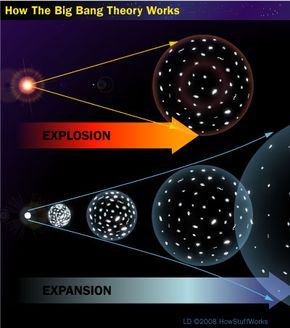
Although How the Big Bang Theory Works covers the origin of the universe in detail, it will be useful to cover the basics here. The short version goes like this: About 15 billion years ago, all matter and energy was bottled up in an incredibly small region known as a singularity. In an instant, this single point of super-dense material began to expand at an astonishingly rapid rate. Astronomers don’t fully understand what caused the expansion to begin, but they use the term “big bang” to describe both the singularity and the first few moments that followed.
As the newborn universe expanded, it began to cool down and become less dense. Think of a jet of steam issuing from a teakettle. Near the spout lid, the steam is quite hot, and the steam molecules are concentrated in a confined space. As the steam moves away from the kettle, however, the steam cools down as the molecules spread throughout your kitchen. The same thing happened after the big bang.
Within roughly 300,000 years, everything held within the singularity had expanded into a seething, opaque sphere of matter and radiation. As it did, the temperature dropped to 5,432 degrees Fahrenheit (3,000 degrees Celsius), allowing more stable particles to form. First came electrons and protons, which then combined to form hydrogen and helium atoms.
The universe continued to expand and thin out. You might be tempted to picture this young universe as a stew, with clumps of matter floating in thick gravy. But astronomers now think it was more like a soup, very smooth in density except for a few tiny fluctuations. These disturbances were just significant enough to cause matter to coalesce.
Huge clusters of protogalaxies began to form. The protogalaxies matured into galaxies, great islands of gas and dust that gave birth to billions of stars. Around some of those stars, gravity pulled together rocks, ice and other materials to form planets. On at least one of those planets, life evolved, some 11 billion years after the big bang started it all.
Today, the universe continues to expand, and astronomers have evidence to prove it. Up next, we’re going to examine some of that evidence.
Evidence for the Big Bang
If the big bang theory is correct, then astronomers should be able to detect the expansion of the universe. Edwin Hubble, the namesake of the Hubble Space Telescope, was one of the first scientists to observe and measure this expansion. In 1929, he was studying the spectra, or rainbows, of distant galaxies by allowing the light from these objects to pass through a prism on his telescope. He noticed that light coming from almost every galaxy was shifted to the red end of the spectrum.
To explain the observation, he turned to the Doppler effect, a phenomenon that most people associate with sound. For example, as an ambulance approaches us on the street, the pitch of the siren seems to increase; as it passes, the pitch decreases. This happens because the ambulance is either catching up to the sound waves it is creating (increased pitch) or moving away from them (decreased pitch).
Hubble reasoned that light waves created by galaxies were behaving similarly. If a distant galaxy were rushing toward our galaxy, he argued, it would move closer to the light waves it was producing, which would decrease the distance between wave crests and shift its color to the blue end of the spectrum. If a distant galaxy were rushing away from our galaxy, it would move away from the light waves it was creating, which would increase the distance between wave crests and shift its color to the red end of the spectrum. After he consistently observed redshifts, Hubble developed what we call Hubble’s law: Galaxies are moving away from us at a velocity proportional to their distance from Earth.
Today, the redshifts of distant celestial objects stand as strong evidence that the universe is expanding. But anything that expands must eventually stop, right? Won’t the universe, just like a ball thrown into the sky, reach some maximum point of expansion, stop and then start falling back to where it started? As we’ll see next, that’s one of three possible scenarios.
Background Check
Strong evidence for the big bang also comes from the cosmic microwave background (CMB) radiation. These microwaves are the same kind you use to cook food in your kitchen, except they’re spread throughout the universe. In fact, they are so evenly diffused throughout space that astronomers now believe the CMB radiation is the echo of the big bang, the dying gasp of the explosion that gave birth to the cosmos we know today.
Beyond the Big Bang
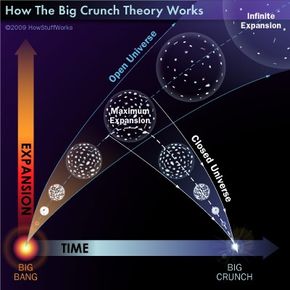
Almost all astronomers accept that the universe is expanding. What happens next is the real mystery. Luckily, there are only three real possibilities: The universe can be open, flat or closed.
Open Universe. In this scenario, the universe will expand forever, and as it does, the matter it contains will spread thinner and thinner. Eventually, galaxies will run out of the raw materials they need to make new stars. Stars that already exist will slowly extinguish, like dying embers. Instead of fiery cradles, galaxies will become coffins filled with dust and dead stars. At that point, the universe will become dark, cold and, unfortunately for us, lifeless.
Flat Universe. Imagine a marble rolling on an infinitely long wooden surface. There’s just enough friction to slow the marble down, but not enough to do it quickly. The marble will roll for a long time, eventually coasting to a slow and gentle stop.
This is what will happen to a flat universe. It will consume all of the energy from the big bang and, reaching equilibrium, coast to a halt far into the future. In many ways, this is just a variation of the open universe because it will take, literally, forever for the universe to reach the equilibrium point.
Closed Universe. Tie one end of a bungee cord to your leg, the other end to the rail of a bridge and then jump off. You’ll accelerate downward rapidly until you begin to stretch the cord. As tension increases, the cord gradually slows your descent. Eventually, you’ll come to a complete stop, but just for a second as the cord, stretched to its limit, yanks you back toward the bridge.
Astronomers think a closed universe will behave in much the same way. Its expansion will slow down until it reaches a maximum size. Then it will recoil, collapsing back on itself. As it does, the universe will become denser and hotter until it ends in an infinitely hot, infinitely dense singularity.
A closed universe will lead to a big crunch — the opposite of the big bang. But what are the odds that a closed universe is more probable than an open or flat universe? Astronomers are beginning to come up with some educated guesses.
Gravity vs. Expansion
To determine if the universe will expand forever, coast to a stop or collapse on itself, astronomers must decide which of two opposing forces will win a cosmic tug-of-war. One of these forces is the bang part of the big bang — the explosion that catapulted the universe outward in all directions. The other force is gravity, the pull one object exerts on another. If the gravity within the universe is strong enough, it could reign in the expansion and cause the universe to contract. If not, the universe will continue to expand forever.
Although astronomers know the universe is expanding, they can’t precisely gauge the force responsible for the expansion. Instead, they try to measure the density of the universe. The higher the density, the greater the gravitational force. Applying this logic, there must be a density threshold — a critical limit — that will determine if the gravity within the universe is strong enough to halt the expansion and reel everything back in.
If the density is greater than the critical limit, then the universe will stop expanding and start contracting. If it’s less than the critical limit, then the universe will expand forever. Astronomers represent this mathematically with the following equation:
Ω = actual average density/critical density
If omega (Ω) is greater than 1, then the universe will be closed. If it’s less than 1, the universe will be open. And if it’s equal to 1, the universe will be flat. Based on the matter we can see, such as galaxies, stars and planets, the density of the universe seems to be below the critical value. This would suggest an open universe that will expand forever.
But cosmologists think there is another type of matter that can’t be seen. This dark matter may account for much more of the universe than ordinary, visible matter and may have enough gravity to stop, and then reverse, the expansion.
Recently, astronomers have made some observations that indicate there’s another invisible material in the cosmos: dark energy. Could dark energy profoundly affect the universe’s fate?
We’re Big on “Big“
The term “big bang” started as a joke — a derogatory remark made by astronomer Fred Hoyle. But the name stuck and spawned a series of nomenclature knockoffs. A universe that expands forever will yield a “big chill” or a “big freeze.” A universe that collapses into a singularity and explodes outward again will experience a “big crunch” followed by a “big bounce.” And a universe that reaches equilibrium and does nothing will become a “big bore.”
The Role of Dark Energy
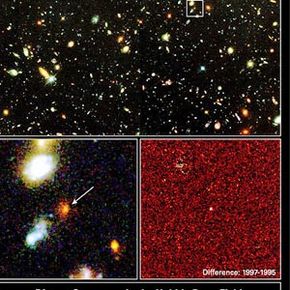
Just as astronomers were grappling with the impact of dark matter, they made a discovery that caused them to go back to the chalkboard once again. The discovery came in 1998, when the world’s best telescopes revealed that type Ia supernovae — dying stars that all have the same intrinsic brightness — were farther away from our galaxy than they should have been. To explain this observation, astronomers suggested that the expansion of the universe is actually accelerating or speeding up. But what would cause the expansion to go faster? Isn’t the gravity inherent in dark matter strong enough to prevent such an expansion?
As it turns out, there’s more to the cosmic story than previously thought. Some cosmologists now think that something else — something just as inexplicable and unobservable as dark matter — is lurking in the universe. They sometimes refer to this invisible stuff as dark energy.
Unlike gravity, which pulls on the universe and slows its expansion, dark energy pushes on the universe and works to speed up the expansion. And there’s a lot of it. Astronomers estimate that the universe might be 73 percent dark energy. Dark matter, they think, makes up another 23 percent, and ordinary matter — the stuff we can see — makes up a paltry 4 percent [source: Brecher]. With numbers like that and given that dark energy is an inflationary force, it’s easy to see how the big crunch might never happen at all.
Interestingly, Albert Einstein predicted the existence of dark energy back in 1917 as he tried to balance the equations of his general theory of relativity. He didn’t call it dark energy at the time. He referred to it as the cosmological constant and labeled it lambda in his calculations. Although he couldn’t prove it, Einstein thought there must be a repulsive force in the universe to spread everything around so evenly. Eventually, he recanted, calling lambda his greatest blunder.
Now, scientists are wondering if Einstein may have been right once again — unless, of course, he’s wrong. Up next, we’ll explore why some still hold the big crunch in high regard and why it might not be the end of the universe, but a second beginning.
Death and Rebirth
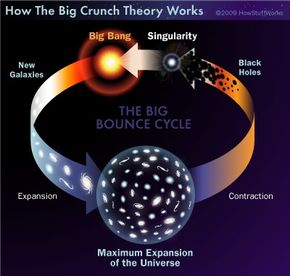
Clearly, there’s no easy answer when it comes to predicting the fate of the universe. But let’s imagine for a moment that the density of the universe is above the critical value required to stop expansion. This would lead to the big crunch, which in many ways would be like hitting the rewind button on a VCR. As gravity within the universe pulled everything back, galaxy clusters would draw closer together. Then individual galaxies would begin to merge until, after billions of years, one mega-galaxy would form.
Inside this gigantic cauldron, stars would meld together, causing all of space to become hotter than the sun. Eventually, stars would explode and black holes would emerge, slowly at first and then more rapidly. As the end drew near, the black holes would suck up everything around them. Even they would coalesce at some point to form a monstrous black hole that would pull the universe closed like a drawstring bag.
At the end, nothing would remain but a super-hot, super-dense singularity — the seed of another universe. Many astronomers think the seed would germinate in a “big bounce,” starting the whole process over again.
That’s not the only theory. A few cosmologists, led by Paul J. Steinhardt of Princeton University and Neil Turok of Cambridge University, have recently argued that the big chill and the big crunch are not mutually exclusive. Their model works like this: The universe began with the big bang, which was followed by a period of slow expansion and gradual accumulation of dark energy. This is where we are today.
What happens next is highly speculative, but Steinhardt and Turok believe that the dark energy will continue to accumulate and, as it does, will stimulate cosmic acceleration. The universe won’t ever stop expanding, but will spread out over trillions of years, stretching all matter and energy to such an extreme that our one universe will be separated into multiple universes. Inside these universes, the mysterious dark energy will materialize into normal matter and radiation. This will trigger another big bang — perhaps several of them — and another cycle of expansion.
If you’re disconcerted by all this talk of crunching and expanding, you can take comfort in knowing that the fate of the universe won’t be determined for billions, maybe even trillions, of years. That gives you plenty of time to focus on things that are a bit more certain, such as your own life cycle of birth, growth and death.
Big Crunch Theory FAQ
What are three possible fates of the universe?
Three fates of the universe that scientists have floated include the big crunch, where the universe compresses, or crunches back together again into a singularity, the big rip, where the universe keeps expanding and eventually rips apart, and a third idea called the big freeze where the universe keeps expanding, star formation eventually ends and the only thing left are black holes.
What is the theory of the big crunch?
According to this theory, the universe will one day stop expanding. Then, as gravity pulls on the matter, the universe will begin to contract, falling inward until it has collapsed back into a super-hot, super-dense singularity.
Is the big crunch possible?
Luckily, the big crunch is not a guarantee. Cosmologists are currently engaged in a hot debate. One camp says the soufflé will fall; the other camp says the soufflé will expand forever. It will be billions of years before we know for sure which camp is right.
How does the universe end according to big crunch theory?
If the theory holds true, the universe is like a giant soufflé. It starts out small, then expands as it heats up. Eventually, however, the soufflé cools and begins to collapse.